

Beyond Just Drills: Teaching Kids to Read the Game
July 08, 2025
6 min
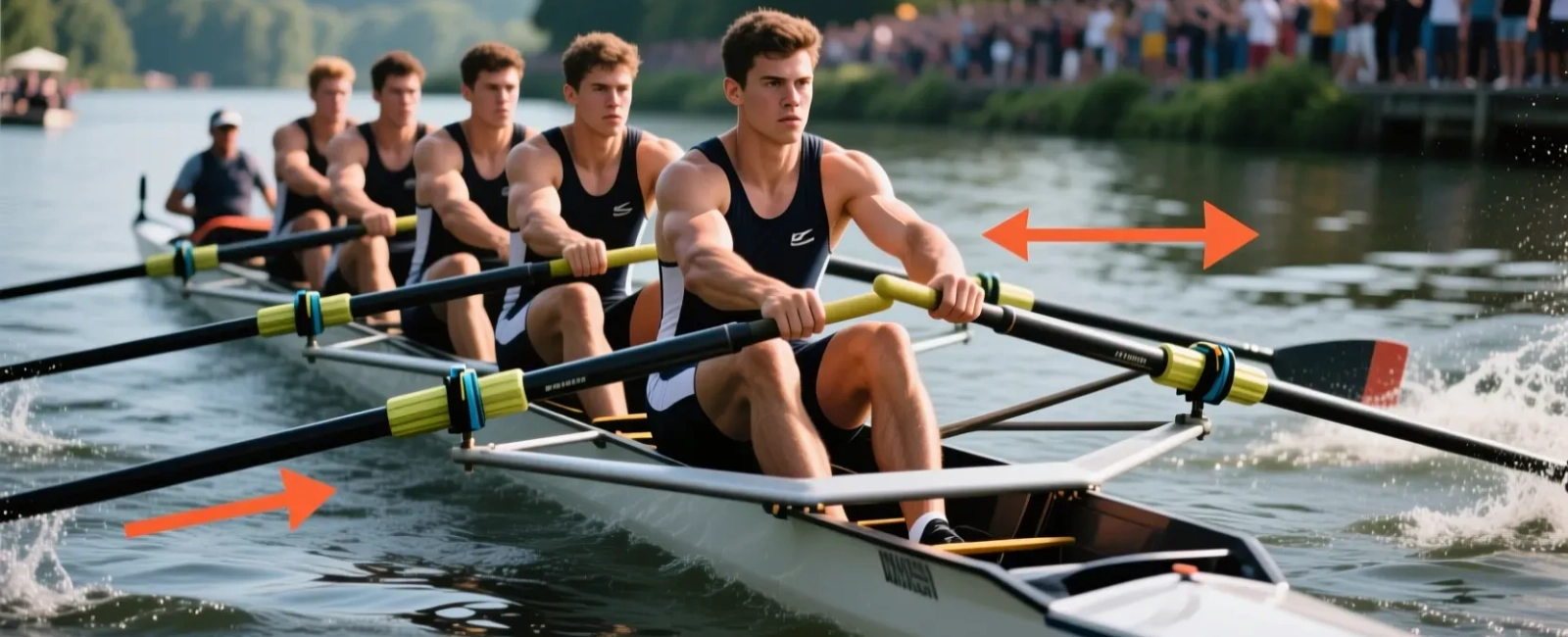
If you’ve ever watched a crew race from the shore, the first thing that strikes you is the symphony of it all. Eight bodies moving as one, the sleek vessel darting across the water like a needle. What you can’t see from that distance is the intricate, physical conversation happening between each rower and their equipment. This dialogue—the application of force, the timing of movements, the management of the body’s own weight—is the essence of rowing biomechanics. Getting it right doesn’t just make a boat go faster; it forges a kind of disciplined intelligence that serves young people far beyond the riverbank. Today, we’re going to look at a few of the most profound adjustments in this dialogue that can fundamentally reshape a rower’s performance.
Most spectators see a rowing stroke as one big motion: a reach, a pull, a return. In truth, high-speed video and force sensor data reveal it as a sequence of eight distinct micro-phases: five during the driving portion of the stroke, and three as the rower recovers for the next. This segmentation isn’t academic; it’s the blueprint for efficiency. The critical transition happens at the very beginning, the moment the blade enters the water—the catch.
A common and costly error is a catch where the rower’s body weight is still moving toward the stern, or where the shins haven’t quite reached vertical. The systematic review of on-water rowing stresses that an optimized catch angle and precise timing are non-negotiable for generating immediate propulsive force. Think of it like a car starting in third gear; there’s a shudder, a lag, a waste of fuel. A proper catch is first gear: a direct, immediate connection where the legs are poised to press against the foot-stretcher without any slippage or compromise.
The data shows stroke rates can vary dramatically, from 20 to 41 strokes per minute. At higher rates, the time to nail this catch sequence shrinks, yet its importance magnifies. A poorly executed catch at a high rate doesn’t just lose a bit of power; it disrupts the entire rhythm of the drive phase, forcing the rower to make desperate, compensatory movements with their back and arms to reclaim lost momentum. The fix here is deliberate, slow-motion drilling on the “pick drill,” focusing solely on the moment of entry. The goal is to create a sensation of hanging your body weight from the handle at the instant the blade locks in, allowing the powerful leg drive to do its primary work without fighting against a moving, unstable platform.
There’s a pervasive belief that a stronger athlete automatically means a faster boat. The biomechanical evidence strongly contests this. Raw strength is merely potential energy; boat speed is the result of how that force is applied over time—the impulse. The 2002 biomechanical model makes a compelling case that rowing is inherently non-optimized because of the large, repeated accelerations of the rower’s mass within the shell. Essentially, during the drive, the rower accelerates faster than the boat-shell system, and during the recovery, they must accelerate in the opposite direction. This creates a wasteful “see-saw” effect.
The key to minimizing this waste lies in the sequencing of the large muscle groups. Research from CrossFit’s analysis of rowing biomechanics indicates that the greatest handle force occurs in the first 40% of the stroke cycle. This force is generated almost exclusively by the legs and the initial engagement of the trunk. The arms contribute later, and crucially, their contribution diminishes as stroke rate increases. This is a revolutionary insight for many developing rowers who instinctively want to “row with their arms.”
The transformative fix is to cultivate a patient upper body. The drive should feel like a controlled fall backward, initiated by the legs, then supported by the trunk swinging open from the hips, with the arms acting merely as cables connecting that generated power to the handle. A useful visualization is to imagine pushing the boat away from the buried blade with your feet, rather than pulling the handle toward your chest. This mental shift encourages the correct sequencing. When the arms fire too early, they create a weak, isolated force that robs the legs of their load and dramatically increases the strain on the lower back, as the lumbar spine becomes the pivot point for the entire system’s power.
Technique crumbles under fatigue. A beautiful stroke at the starting line can degrade into a ragged, inefficient series of movements by the final 500 meters. The most common failure point is postural integrity. We are not just talking about “sitting up straight.” We are talking about maintaining the structural alignment that allows force to travel from the foot-stretcher, through the body, and to the handle without leakage.
The comparison between experienced and novice rowers in the available research is telling. Novices often exhibit a collapsing chest, rounded lower back, or a posterior tilt of the pelvis as fatigue sets in. This isn’t just an aesthetic issue; it’s a biomechanical catastrophe. A rounded back shortens the effective stroke length, disengages the core, and places the spinal ligaments and discs under dangerous shear forces. It also destroys the smooth, rotational path of the handle, causing the boat to check and slow down at the beginning and end of each stroke.
The fix here is two-fold and must be ingrained long before exhaustion hits. First, develop a conscious awareness of the “weight-bearing column” from the tailbone through the crown of the head. This is supported by a strong, engaged core that acts as a stabilizer, not a prime mover. Second, understand that recovery posture is just as critical as drive posture. Slouching or rushing up the slide during recovery doesn’t just set you up for a bad catch; it actively slows the boat. The body must be moved with control, as a consolidated unit, to minimize that extraneous acceleration of mass that the 2002 model identifies as so damaging. Drills that involve rowing with a pause at the finish or at “hands away” can build the muscular endurance and neural pathways needed to hold this framework when the body is pleading to collapse.
What we’re really discussing is the physics of character. The discipline to refine a catch, the patience to sequence a drive, the fortitude to hold a posture—these are not just methods for moving a boat. They are principles for managing much heavier loads. The beauty of rowing lies in this direct feedback: when the dialogue between body and shell is clear, the boat runs free and fast. When it’s muddled, everything feels heavy. By focusing on these deep, biomechanical conversations, we help young athletes learn to speak the language of focused effort, where every action has a clear and purposeful effect.
