

Hydration: Your Secret Weapon for Peak Performance
December 05, 2025
5 min
Forget Everything You Think You Know About “Practice Makes Perfect”
You ever watch a kid at practice, hitting the same shot or throwing the same pitch over and over until their arms are about to fall off? They look solid, right? You’re thinking, “Wow, they’ve really got it down.” Then game day rolls around and suddenly… it all falls apart. The pitch sails wild. The batter looks frozen. What happened? Weren’t they just doing it perfectly ten minutes ago?
Let’s be honest. It drives you nuts. You spent hours tossing balls in the yard, you bought the gear, you cheered from the bleachers. So why does the skill vanish when it actually counts?
The problem isn’t the effort. It’s probably the way we’re practicing. We’re building a skill in a quiet garage and then expecting it to work in a hurricane. I’ve been in the dugout and on the board for years, and I’ve seen this movie a hundred times. But there’s a different way to approach this, something that actually sticks when the pressure’s on. It’s not a fancy new drill or some magic gadget. It’s a simple shift in how we think about building skills. I call it the Chunk-Practice-Connect method. Sounds simple, right? It is. But the devil, and the real progress, is in the details.
We all default to it. Do the thing. Then do it again. And again. Twenty free throws in a row. Fifty swings off the tee. It feels productive. It looks tidy. The numbers go up! Kids get that immediate “I did it!” feeling. Science even has a name for this: blocked practice. And it’s fantastic… for making you better at practice.
Here’s the catch, the one the research shouts about but we often ignore. That study on motor learning points out a brutal truth: getting really good at repeating a skill in a sterile, predictable environment mostly teaches your brain to rely on instant feedback to correct itself. You’re in a constant state of micro-adjustment. “Last one was left, so adjust my elbow this time.” It’s like learning to drive a car by only ever backing out of your own driveway. You’ll master that specific ten-foot maneuver, but good luck merging onto the freeway.
Your brain is clever. It takes the path of least resistance. If you’re doing the identical motion from the identical spot, it starts to package that whole sequence—the bend of the knees, the flick of the wrist—into one neat little bundle, a “motor chunk.” This is handled by deep parts of your brain (the basal ganglia, if you want the term) so you don’t have to think about each step. That’s the goal! But if that chunk is only built in your quiet driveway, it’s a fair-weather chunk. It crumples under the slightest bit of change.
This is where that other study’s idea of an “internal model” comes in. Think of it as your brain’s prediction software for a skill. Blocked practice builds a weak model. It only knows how to predict the outcome for that one, perfect scenario. Throw in a defender, a different angle, or just the heartbeat-thumping silence of a game-deciding moment, and the software crashes. The kid has to go back to thinking step-by-step, and under pressure, that thinking system jams up. What looks like choking is often just a brain desperately trying to use the wrong tool for the job.
So if doing the same thing forever is a dead end, where do we start? We start small, but we start smart. This is the “Chunk” part.
Skills aren’t monoliths. A softball pitch isn’t one thing. It’s the wind-up, the arm circle, the release, and the follow-through. A football throw is the grip, the footwork, the shoulder turn, the release. Trying to learn it all at once is like trying to swallow a whole steak. You’ll choke. The trick is to cut it into bite-sized pieces your kid can actually chew.
The tennis research talks about this beautifully. They call it “chunking”—grouping related pieces of a skill into a bigger, manageable unit. For a beginner, a chunk might be tiny: just getting the grip right and making contact with the ball. That’s it. For a more experienced player, a chunk becomes “the approach shot,” which includes foot movement, racket preparation, and shot selection all bundled together.
Your job is to figure out what size chunk your young athlete can handle right now. Not where you want them to be, but where they actually are. Watch them struggle. Where does it break down? Is the throwing motion okay but the footwork a mess? That footwork is its own chunk. Work on that piece alone. Forget the target. Forget the ball speed. Just get the feet right until it’s not a conscious struggle anymore.
This isn’t about perfect repetition of the chunk. It’s about building a solid, reliable bundle their brain can trust. You know they’ve got a chunk down when they can do it without you barking reminders every two seconds. The look of intense concentration fades a bit. It starts to look… fluid. That’s the sign. That chunk is ready to be stressed, varied, and connected to something else.
Alright, you’ve got a solid chunk. Your kid can step and throw with decent form in the backyard. Now the real work begins. This is where we move from building the bundle to stress-testing it. We need to make that chunk resilient.
Enter variable practice. This is the polar opposite of blocked practice, and at first, it feels wrong. It looks messy. It’s less satisfying in the moment. You’re going to see more mistakes, and you’re going to have to bite your tongue.
Instead of twenty throws from the same spot, you mix it up. Throw from the knees. Throw off one foot. Throw to a moving target (a walking sibling works great). Throw a wiffle ball, then a tennis ball, then a real ball. In basketball, don’t shoot 100 free throws. Shoot five from the line, then one from the wing, then a layup, then two more from the line. Mix the order constantly.
Remember that study on variable practice? It showed that while performance during the practice session is lower (fewer swishes, more wild throws), the long-term learning and transfer to game situations is massively better. Why? Because you’re forcing the brain to build that “internal model” I mentioned earlier. You’re not letting it get lazy and just repeat a command. You’re making it solve the problem again and again: “Okay, now I’m off-balance, how do I adjust my chunk to still make an accurate throw?” “Now the target is moving, what do I change?”
Think about Rudy Gobert, the NBA player mentioned in that research. He practices bizarre shots from all over the court—hooks from the three-point line, floaters from weird angles. He’ll probably never take those shots in a game. But by practicing them, he’s not learning a specific shot; he’s deepening his brain’s understanding of the core principles of shooting—arc, touch, release—under all kinds of constraints. He’s building a bulletproof internal model for the shots he does take.
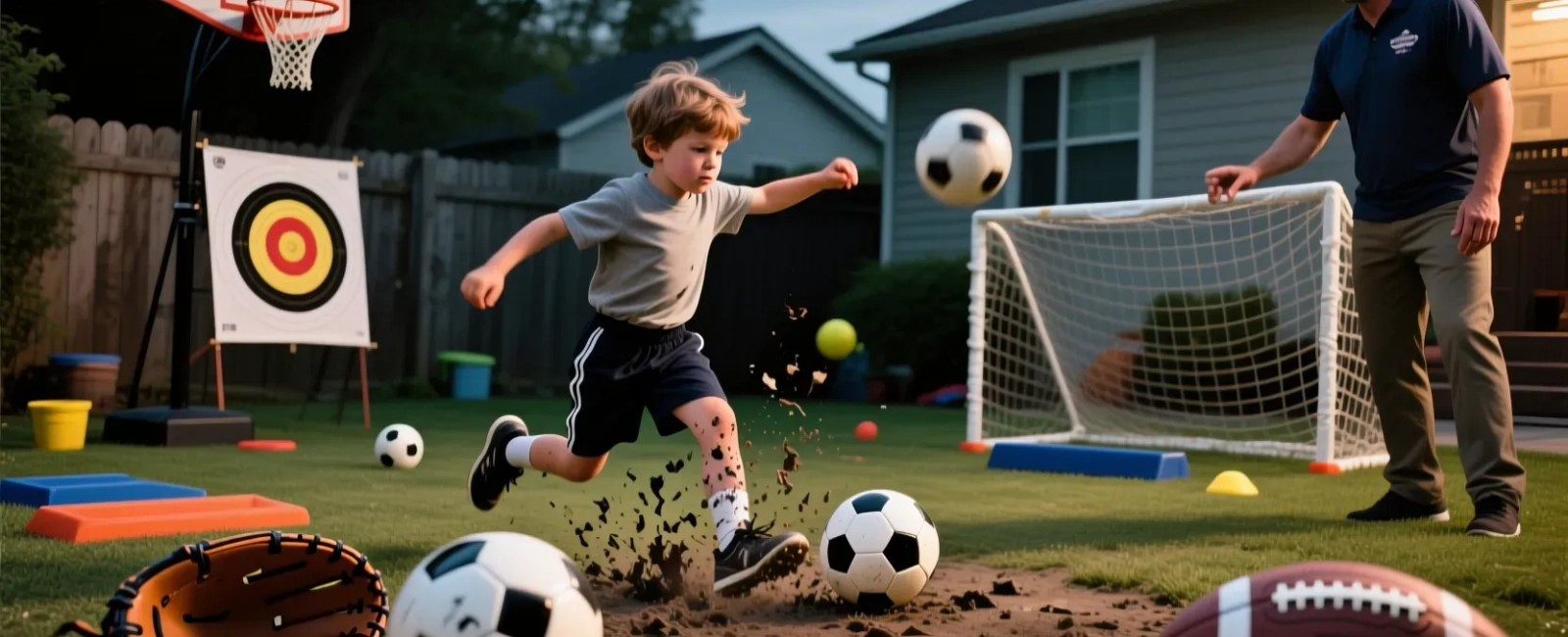
Your version of this doesn’t need an NBA gym. Set up a “messy station” in your yard.
The key is minimal change with maximal effect. You’re not asking for a whole new skill. You’re asking for their well-practiced chunk to adapt. This phase is frustrating. Progress isn’t a straight line. Some days it feels like they’ve forgotten everything. That’s normal. The brain is rebuilding a stronger, more flexible version of that skill bundle.
Here’s where most well-meaning practice plans truly fall short. You’ve built a chunk. You’ve varied it. But if you don’t connect it to something that looks and feels like the actual sport, you’ve just built a beautiful engine and left it on a stand. It needs to be in the car, on the road.
The academics have a stiff term for this: “representative learning design.” All it means is that your training should look like your competition. This is the “Connect” in the method. It’s where chunks get assembled into the full performance.
This means you absolutely must add the elements of the game back in as soon as the chunk is stable enough. For a pitcher, that means throwing to a catcher (even a sibling with a mitt), not just at a target. Then add a pretend batter. Then add a consequence: “This pitch is for the championship, runners on base.” For the flag football QB, it means throwing while a little brother runs around waving arms as a “pass rush.” For the batter, it means live pitching from a parent or coach, even if it’s just easy tosses, with the instruction to “run to first” on contact.
That tennis research is adamant about this: “Coaching tip prioritizes live ball drills in later stages.” The “live ball” is the critical piece. It’s unpredictable. It carries pace and spin you don’t control. It forces perception and decision-making to hook onto the motor chunk. The player isn’t just executing a bundle of moves; they’re reading a situation and selecting the right bundle from their toolkit.
This connection phase is where the magic of long-term learning happens. The study on skill acquisition calls this “contextual interference,” and it leads to far better retention. You’re simulating the cognitive workload of the game. Where does the ball need to go? What’s my opponent doing? What’s the score? By connecting your messy, variable practice to these game-like questions, you’re wiring the skill into the brain in the same way it will be used. You’re building highways, not dead-end streets.
Let’s walk through teaching a basic outfield throw to home plate.
You’ll know it’s working when you see the thinking disappear. They won’t look at their feet anymore. They’ll see the ball, their body will execute the chunked footwork, and their arm will follow through. They might not be perfect—the throw might be off-line—but the process will be sound. The skill will hold up under the heat.
This method requires patience. It asks you to value messy, inconsistent effort over clean, repetitive success. It forces you to watch for the right signs of progress—not a higher score in a sterile drill, but a smoother application in a chaotic, game-like scenario.
It’s not a quick fix. It’s a different road. But it’s the road that leads to the skills we all want for our kids: the ones that don’t vanish when the lights come on. The ones that are truly theirs, built to last. So next time you’re in the yard, resist the urge to just mindlessly repeat. Break it down, mess it up, and connect it to the game. You might be surprised at what sticks.
