

Diamond Dreams: Turning Practice Challenges Into Wins
November 24, 2025
4 min
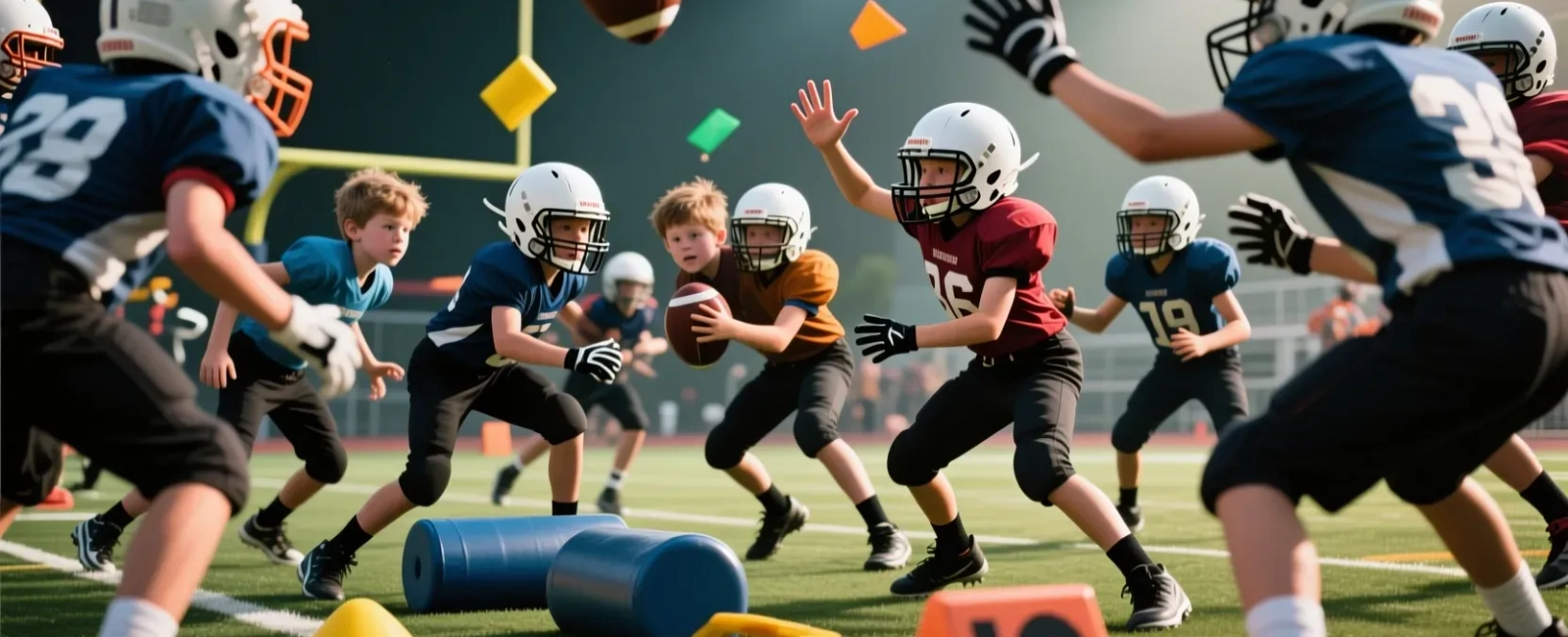
Ever watch a youth football game and see that kid who looks fantastic in practice just… freeze? The play breaks down, the pocket collapses, and suddenly all those perfectly rehearsed drills go straight out the window. Or maybe your softball pitcher can hit a spot every time in the bullpen, but put a runner on third and the game on the line, and that beautiful mechanics fall apart.
What’s happening there? We spend hours running our kids through clean, repeatable drills. We want things neat and orderly. But here’s the uncomfortable truth: a game is none of those things. A game is messy, unpredictable, and downright chaotic. And if we’re not building skills that work inside that mess, we’re preparing them for a sport that doesn’t actually exist.
I’ve seen it from the sidelines for years. The teams that consistently find a way to win, especially when things get wild, aren’t always the ones with the biggest stars. They’re the ones whose players don’t seem surprised by the chaos. They adapt. They make a play. This isn’t just luck or grit—it’s a trainable skill. Sports science backs this up with something called the Control-Chaos Continuum (CCC). It’s a structured method, born from rehabbing elite athletes, that systematically prepares players for the bedlam of competition. And its principles are pure gold for developing young athletes.
Why “Chaos” Isn’t a Dirty Word
Let’s be clear: chaos drills aren’t about throwing kids into a free-for-all and hoping they figure it out. That’s just poor coaching. The chaos we’re talking about is carefully introduced confusion. It’s adding a single defender where there was none. It’s requiring a receiver to read a coach’s hand signal before running their route. It’s a pitcher working with a runner taking a lead.
Research on this framework shows it bridges the gap between the sterile clinic and the live game. One study breaks the journey into five phases, moving from straight-line running all the way to “worst-case scenario” drills that mimic the most demanding, unpredictable moments of a match. The critical insight? This isn’t a light switch you flip from “control” to “chaos.” It’s a slider you move gradually, based on what the player can handle.
Think about a quarterback. We can drill a three-step drop and throw forever. That’s high control. Now, add a moving trash can he has to avoid in the pocket before throwing (moderate control). Next, add a passive rusher who puts a hand up (control-to-chaos). Then, a live rusher, but the quarterback knows the play (increased chaos). Finally, a live rusher with a coverage shell he has to read after the snap (high chaos). Each step feels incrementally harder, but none of them are the massive, confidence-shattering leap from a clean pocket to a live blitz.
Building the Bridge: Where Most Practices Stumble
The biggest hole in most practice plans is the middle of that continuum. We have the “technique work” and we have the “scrimmage.” The magic happens in the muddy middle ground. This is where you build adaptability.
Take a flag football drill on angles. A standard drill has a kid run a precise out route. Fine. Now, introduce what the research calls “applied constraints.” As the receiver starts his break, a coach standing five yards away holds up one, two, or three fingers. The receiver has to call out the number and then run the corresponding route (one finger = out, two = slant, three = go). Suddenly, they’re not just running. They’re scanning, processing, deciding, and acting—all while moving at speed. That’s a cognitive layer on top of the physical skill.
This aligns with what scientists call “two-step” problem solving. The athlete must identify the stimulus (the fingers) and then execute the correct motor response. In a game, that stimulus is a defender’s leverage or a teammate’s cut. This type of drill makes that neural pathway faster and more reliable.
Another method from the studies is using “live positional pattern-of-play drills.” In baseball or softball, this isn’t just taking ground balls. This is setting up a full infield with base runners. Hit a ball to shortstop, but don’t tell the runners what to do. They have to react live. The shortstop fields it, but now she has to process: Is the runner going? How hard was it hit? Where’s my throw? It looks like a scrimmage, but it’s focused on a specific group. The chaos is elevated because the players are creating it for each other, but the coach can stop it to teach within the chaos.
The Mental Maze: It’s Not Just About the Body
This is where it gets really interesting. That feeling of being “flustered” or “in your own head” during a game has a scientific basis. Our brains have limited attentional resources. When a environment is overloaded with stimuli—crowd noise, a shifting defense, a coach yelling—performance can crack.
Chaos training directly challenges this. Some drills, based on “Limited Resource” Theory, force a player to use the same mental “fuel” for two tasks. For example, a linebacker in a pursuit drill might have to watch the ball carrier’s hips while also responding to a color a coach shouts to determine his finish path. It’s taxing.
Other drills use “Multiple Resource Theory,” which is like asking your brain to switch channels quickly. A softball pitcher might work on her motion while a coach, standing off to the side, occasionally flashes a number. She has to call it out without stopping her delivery. She’s not doing two things at once, exactly; she’s rapidly toggling her focus. This builds the mental agility needed to check a runner and then focus back on the catcher’s sign.
Research on athletes returning from knee injuries found they reported much higher mental strain during these chaotic, decision-heavy drills compared to simpler ones. Their heart rates were also higher—not just from physical effort, but from cognitive load. Their brains were working harder. That’s the kind of workout we rarely give our players, but it’s essential for game day.
Putting It Into Practice (Without Losing Your Mind)
So how do you, as a coach or a parent helping out, actually do this without creating a circus?
First, start with a single variable. You don’t need to reinvent practice. Take a drill you already do and add one unpredictable element. For a baseball hitting drill, instead of telling the kid “fastball middle,” have the coach pitcher point to a zone after the wind-up begins. The hitter has to identify location and swing. Small change, massive difference in demand.
Second, use “shared decision-making” on risk. This is a brilliant concept from the research. If you have a player coming back from a tweaked ankle or who’s just struggling with confidence, collaborate. You might agree that in a small-sided game, they can self-limit—maybe they only go 80% on cuts, or they have a “no-contact” rule. This lets them engage in the chaotic environment without the full strain, building confidence within the mess.
Third, design for failure, then teach. The goal of a chaos drill isn’t perfect execution. It’s to see where the breakdown happens. Does the receiver drop the ball because he looked for the flag pull too early? Did the soccer defender forget to mark the second runner because he was only watching the ball? The mistake is the lesson. Stop the drill there and talk about it. “What did you see? What else could you have looked for?” This turns chaos into the world’s best teacher.
Finally, embody the team interaction. The studies point out that interacting with teammates provides the richest, most unpredictable chaos. A 2v2 possession game in football, a 3-on-2 fast break drill in basketball—these are engines for chaos. Players have to read each other, make unspoken agreements, and react to mistakes in real time. This should be the peak of your practice chaos before a full scrimmage.
Winning isn’t about having robots who can perform a skill in a vacuum. It’s about having adaptable, resilient kids who can solve problems while tired, under pressure, and surprised. It’s about building athletes who are comfortable being uncomfortable. That ability starts when we have the courage to turn down the control in practice—just a little bit at a time—and let the beautiful, complicated, chaotic game become their classroom. Stop preparing them for perfect. Start preparing them for real.
